




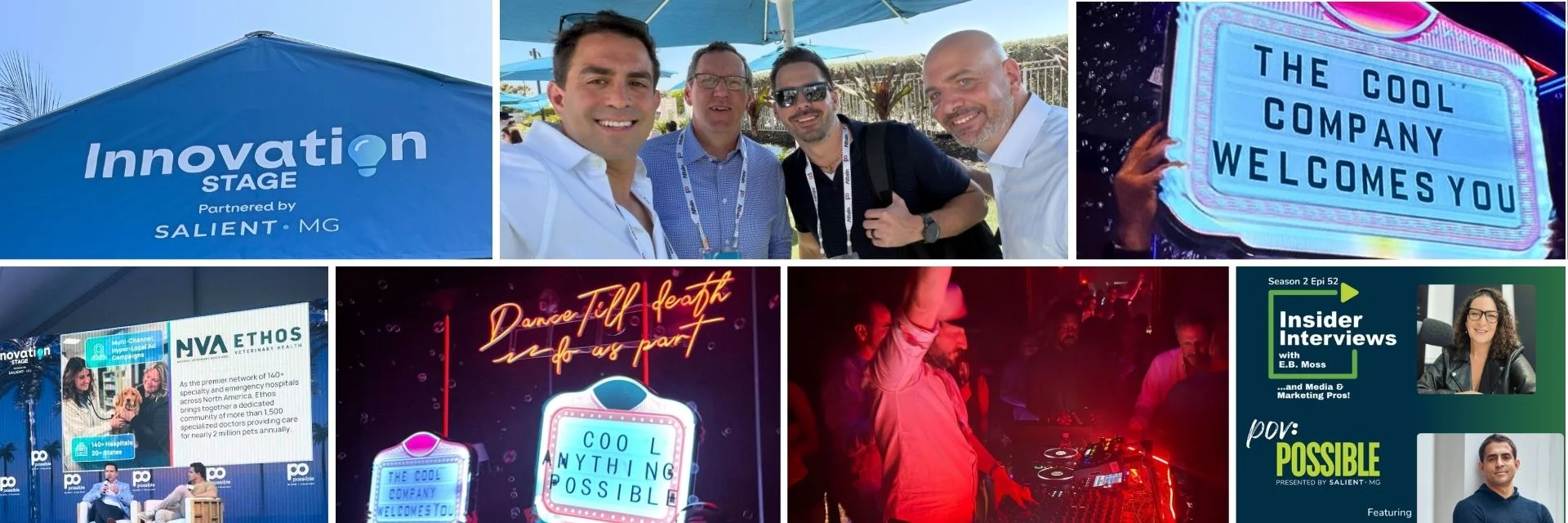
There was no shortage of AI conversation at POSSIBLE this year—but what stood out wasn’t the volume. It was the shift. This year, the tone changed.
The conversation moved from theory to execution. Teams aren’t speculating. They’re sharing what’s actually happening inside live campaigns. What’s driving results, what’s falling short, and how they’re adjusting in real time.
Here are three takeaways that stood out:
1. The Real Shift Isn’t AI in Channels—It’s AI Across Them
For years, optimization has lived inside platforms. Google optimizes Google. Meta optimizes Meta. Each channel gets smarter—but only within its own walls.
Now, it’s possible to optimize across channels so you have a single source of truth.
Steve Clouthier, Chief Growth Officer at Ethos Veterinary Health, described what this looks like in practice after implementing an omnichannel campaign using The COOL Company’s platform:
“You’re optimizing results across Google and Meta and all the other platforms that we use… not just within each one. That’s a real bonus for us.”
That distinction matters more than it sounds. Because performance doesn’t happen in isolation. It’s a constant optimization loop where audiences get refined, creatives get tested and rotated, budget gets reallocated and every result feeds into the next decision.
2. AI’s Advantage Is Scale—Thousands of Decisions, Not One Big One
Before AI, optimization was manual, periodic, and limited by time. Teams focused on the few changes big enough to justify the effort.
With AI, that constraint disappears.
Thousands of small, incremental decisions such as bid adjustments, creative rotations, and audience refinements happen continuously.
Individually, they’re almost insignificant. Together, they compound into meaningful performance gains no human team could realistically achieve.
In one example shared on stage, a campaign that had already been manually optimized for years saw 8,600+ adjustments in just two weeks—573 per day across creative rotation, keyword refinement, bid adjustments, and geo-level targeting. The results were hard to ignore: +267% phone leads, +289% booked appointments, 26% lower CPA.
That’s not one big swing. It’s thousands of small ones compounding in real time at a scale no human team can replicate.
3. The AI Playbook is Still Coming
As Steve from Ethos Veterinary Health put it, there isn’t an AI playbook just yet and there probably won’t be for a while. You have to experiment, see how it shows up in your specific business, and build from there. The teams pulling ahead aren’t waiting for the industry to reach consensus. They’re running tests, collecting their own proof, and moving forward with an enhanced approach across omnichannel marketing
Mind the Gap
AI isn’t one big breakthrough. It’s a series of small shifts that are starting to add up—across channels, decisions, and execution. And now, it’s showing up in results.
By this time next year, the gap will be clear between teams that put it into practice and those that sat on the sidelines.