






Modern marketing has more data than ever and less clarity than it should.
For years, media planning was a backward-looking exercise. Teams pulled last year’s spreadsheets, adjusted budgets slightly, and built plans around what had worked before. That approach made sense when media channels moved slowly and consumer behavior was relatively predictable.
Today, it breaks down almost immediately.
Consumer attention shifts across streaming, social, and search environments faster than quarterly plans can keep up. A channel that performs well one month can decline the next as creative fatigue sets in, platform algorithms change, or new competitors enter the auction.
That’s why media planning is moving from historical planning to predictive simulation.
Modern planning systems can analyze first-party data, historical performance, and market signals to model thousands of “what-if” scenarios before a campaign ever launches. Instead of committing to a single media mix, marketers can test how different allocations—like shifting 15% of spend from paid social into CTV—might affect reach, cost efficiency, and incremental conversions.
Today, planning is less about guessing and more about probability.
This shift reflects a broader industry trend. According to the IAB’s State of Data 2025 report, AI is now being used across the full media campaign lifecycle, from audience modeling and planning to buying, optimization, and measurement.
Planning is no longer the start of the campaign. It’s the beginning of a system that continues learning once campaigns go live.
Activation: Intelligence at the Impression Level
If planning is becoming predictive, activation is becoming intelligent.
Launching campaigns used to involve a long chain of manual steps: building audience segments, setting bids, uploading creative, adjusting pacing, and monitoring placements. Today, much of that execution is handled by machine-learning systems that evaluate performance signals continuously.
But the biggest change in activation isn’t just media automation. It’s the convergence of media math and creative intelligence.
Generative AI and dynamic creative optimization (DCO) are removing one of the longest-standing bottlenecks in digital advertising: creative production. Instead of launching campaigns with a handful of assets, marketers can now deploy dozens (or even hundreds) of variations that adapt to different audiences, contexts, and placements.
Headlines can change. Visuals can rotate. Calls-to-action can adjust depending on engagement signals. And this all can happen in minutes.
The system then learns which combinations perform best and increases exposure accordingly, all while maintaining brand guardrails.
This shift dramatically expands the scale at which personalization can occur. McKinsey’s State of AI 2025 report notes that marketing and sales remain among the business functions with the highest potential value from generative AI adoption, particularly through personalization, content generation, and campaign optimization.
In practical terms, activation becomes less about manually managing campaigns and more about launching a performance-driven AI system designed to learn and adapt quickly.
Optimization: The End of the Weekly Report
Optimization used to happen after the fact.
Teams would review dashboards, identify what worked or didn’t, and adjust campaigns. .
AI changes the timeline.
Machine learning systems can analyze performance signals across channels in real time, identifying patterns that would be nearly impossible to detect manually. If a creative variant begins to fatigue on social, but continues to perform on display, the system can adjust rotation instantly. If a particular audience segment begins converting at a higher rate, budget can shift toward that segment automatically.
With AI, optimization becomes continuously embedded rather than periodic.
This shift is happening at the same time the measurement landscape itself is evolving. With privacy regulations tightening and traditional tracking methods becoming less reliable, marketers are increasingly relying on transparent attribution to understand campaign impact.
And there’s another emerging layer marketers are beginning to pay attention to: AI search visibility.
As consumers increasingly interact with conversational systems like ChatGPT, Gemini, and Perplexity, discovery is shifting toward generative interfaces. Instead of scanning ten blue links, users receive synthesized answers generated from multiple sources.
Visibility within answer engines is quickly becoming as important as ranking on the first page of traditional search results.
The New Duo: Human + Machine
All of this raises a natural question: if AI is doing more of the execution, what happens to the marketer?
The answer isn’t replacement. It’s reallocation.
AI is exceptionally good at analyzing large datasets, identifying patterns, and executing repetitive tasks at scale. But those systems still rely on human direction, setting strategy, defining brand voice, establishing guardrails, and interpreting insights.
At The COOL Company, we see this shift as the emergence of a new marketing operating model, one where human strategy and machine intelligence work together.
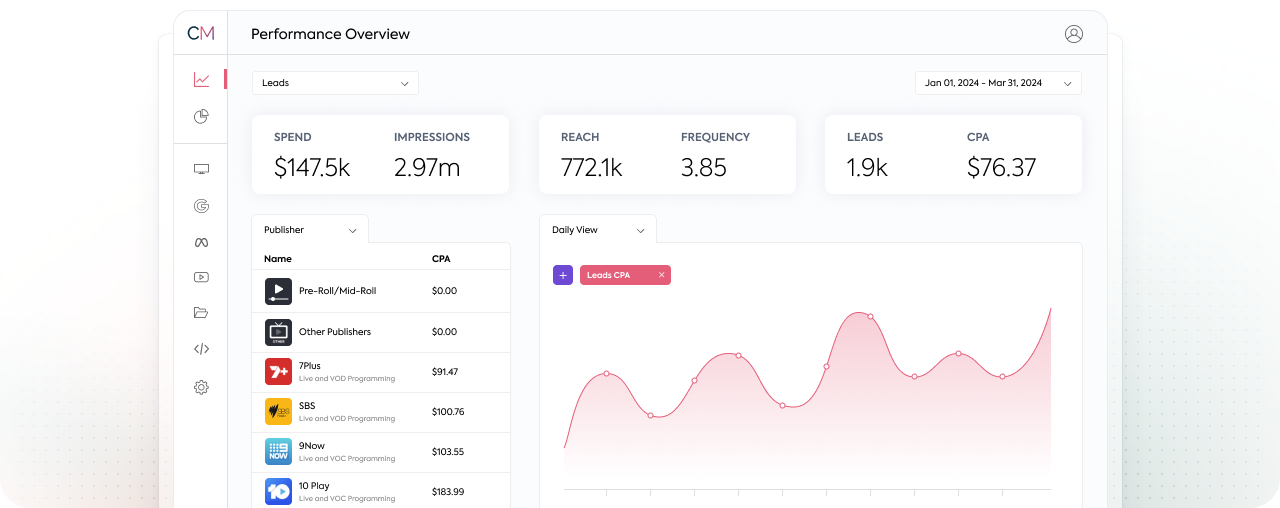
Our platform creates the orchestration layer that connects creative automation, media activation, and attribution intelligence in a single environment, allowing campaigns to launch faster, learn faster, and improve continuously.
When creative performance feeds directly into media optimization (and measurement informs both in real time) the system becomes self-improving, creating breakthrough performance results.